
| ATOMS PART II |

- While the evolution of a “proton” or “neutron” is basically the same as an
electron, following the pattern I just described, there is an important difference.
In measured mass, protons and neutrons are much larger than electrons. Their
mass is larger because their vortices are larger and thus contain more aethrons.
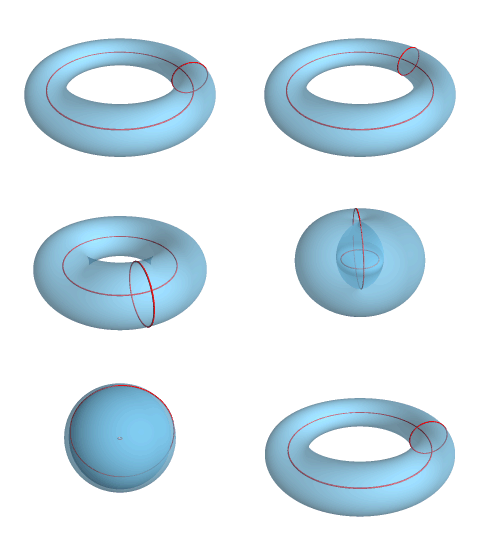
The larger size of these vortices means their shape can vary a great deal
depending on the angular momentum of a respective vortex, which depends, of
course on the state of the aether that surrounds it. The vortex may take the
shape of a ring torus, a horn torus, a horn sphere, a spindle torus, a spindle
sphere, a spheroid, a sphere, an ellipsoid (peanut-shape), or thick-rod shape.
Any number of possible variants, including inversions of the above named
shapes and irregular shapes, emerge while they exist in the dynamic aether-
medium, isolated, or alongside and or connected to other similar vortices. It
seems electrons, being much smaller than protons or neutrons, maintain a
relatively constant torus vortex shape; however, it is possible that they too
change shape fluidly.
- Click HERE for an article that describes the discovery of the fluid shape of the
proton that depends on its angular momentum (incorrectly attributed to the
angular momentum of the "quarks" that "make up" the proton.
- It is likely that neutrons, because of their much larger size than electrons and
protons respectively, have a restricted sink-source loop flow. This is because
the central axis of the latter restricts it to an almost exclusive conical through-
flow.
Home
Natural Philosophy
Atoms Part I - Back
Atoms Part II - Current
Atoms Part III- Next
Atoms Part IV
Atoms Part V
Natural Philosophy
Atoms Part I - Back
Atoms Part II - Current
Atoms Part III- Next
Atoms Part IV
Atoms Part V
Summary of this page:
- The nature of the vortical motion that constitutes in full what sub-atomic particles are is explained. The
specific nature of electrons, protons, neutrons are explained. - Explains why electrons, protons and neutrons are more accurately called quantum vortices, not
quantum paritcles. - Why electrons, protons and neutrons? The seemingly infinite number of quantum particles explained.
| The Kinematics of a Vortex in a Three-Dimensional Fluid |
Please refer to the Gravity Home Page and Gravity Part II a full description of the kinematics of a vortex in
three-dimensions.
three-dimensions.
The nature of quantum-sized vortices
- These vortices are spiral in nature; however, being so small, there is no accretion of aethrons at their centers like
there is with the spiral vortices of gravity systems: quantum particles are not being created at the center of a
quantum particles. A spiral vortex in three-dimensional space takes the shape of a torus. A torus is a sphere that
curves inwards at its poles such that there is a hole through its center. The angular momentum of a torus can cause it
to change shape. I will explain this in a moment.
- These atomic torus vortices are very similar dynamically to gravity spiral vortices. They both share the same sink-
source type of flow through their centers. The vortex that induces a sink-source flow, which in turn maintains the
vortex. I will explain this concept again.
- The initial density of the center of a newly-created torus vortex—which lasts but an instant—is entirely rarefied. Thus,
a flow is induced towards it to equalize the density disturbance. The surrounding aether-medium aethrons move
towards the center of the torus vortex, from “above” or “below,” pass through it, and exit out of it. As aethrons pass
through the center, perpendicularly to the motion of the ring torus vortex, one side of the hole acts as a sink while
the other acts as a source. But the action of the vortex causes a portion of the source-aether that exits to be back-
reflected. The source-aether that is not back-reflected escapes the action of the vortex and does not return. The sink
in turns draws in aether from the sink-side of the torus vortex. What emerges is a complex circulatory system of sink-
to-source-to-sink loops; and, at the source and sink, a conically-shaped flow pattern that represents the aether not
vortex-reflected or sink-reflected.
- According to Bernoulli's principle, as I described earlier in the case of earth's sink-source flow (“magnetic field”), the
high drift-velocity of the sink-source flow has a net low pressure within it that sustains the spiral flow of aether
around it—sustains the torus vortex. While the initial torus vortex creates the sink, the sink-source flow maintains the
sink and the torus vortex; and, while the sink-source flow maintains the torus vortex, the latter maintains half of the
loop-flow of the former. These two types of flows are mutually inclusive and always exist together in atomic systems,
including each of the so-called quantum particles. However, since there is no accretion of aethrons at the centers of
atomic torus vortices, the aethrons that reach the center of the sink are carried out by the sink-source flow. So, as
you can imagine, the aethrons that atomic vortices are ever changing, and are derived from the immediately
surrounding aether-medium. Atoms are truly fluid things.
Electric Charge
The sink-source flow induced in the
surrounding aether-medium is
equivalent to what scientists have
called a particle's “electrical
charge.” But rather than being
some mysterious property that is
neither space nor matter, that can
act at a distance—that is some
matterless force that causes—the
existence of sink-source flow gives
a logical mechanical picture of what
is actually going on in so-called
charged particles.
The sink-source flow induced in the
surrounding aether-medium is
equivalent to what scientists have
called a particle's “electrical
charge.” But rather than being
some mysterious property that is
neither space nor matter, that can
act at a distance—that is some
matterless force that causes—the
existence of sink-source flow gives
a logical mechanical picture of what
is actually going on in so-called
charged particles.
The Electron: A Quantum Vortex Not a Quantum Particle
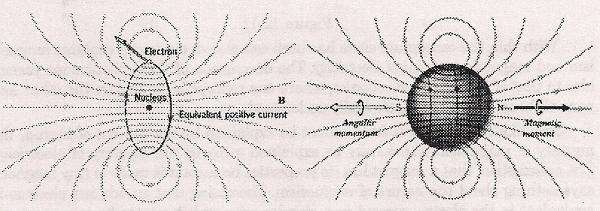
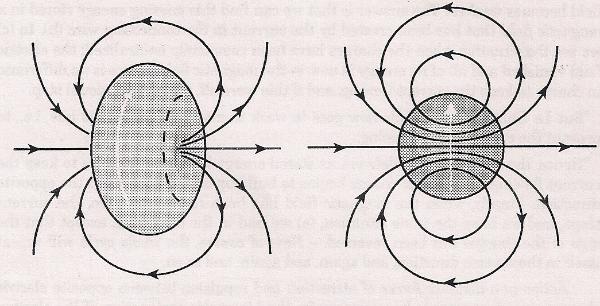
This permanent circulatory pattern—the torus vortex and the loop and conical sink-source flow—is, in all
aspects, equivalent to our empirically verified concept of an electron. Because of the relatively small size of
the electron's torus vortex, the sink-source flow extends over and far beyond the vortex proper. The torus
vortex portion accounts for the permanent “hard particle” of the electron and its “spin”; the sink-source flow
accounts for the “negative charge” of the electron.
aspects, equivalent to our empirically verified concept of an electron. Because of the relatively small size of
the electron's torus vortex, the sink-source flow extends over and far beyond the vortex proper. The torus
vortex portion accounts for the permanent “hard particle” of the electron and its “spin”; the sink-source flow
accounts for the “negative charge” of the electron.
These diagrams compare current
pictures of the atom with the torus
vortex of aethro-kinematics. Note
the exact correlation between the
two. The "hard particle" of the
electron is made of the torus
vortex. The "negative electric
charge" of the electron is made of
its sink-source flowlines.
pictures of the atom with the torus
vortex of aethro-kinematics. Note
the exact correlation between the
two. The "hard particle" of the
electron is made of the torus
vortex. The "negative electric
charge" of the electron is made of
its sink-source flowlines.
| The Proton and Neutron: Quantum Vortices Not Quantum Particles |
It is likely that, for whatever kinematic (or hydrodynamic) reason, protons, neutrons and electrons form the most
stable kind of vortices under the pressure conditions of gravity systems—that is, as opposed to other sizes of
vortices that may be engendered but do not persist. Of course, a great number of different vortices can form under
within the high pressure conditions of a gravity systems (or “particle accelerators”), which would account for the
variety of quantum particles cataloged today. But the electron, proton and neutron are the vortices that together,
for reasons of size, form stable interlocking units—atoms.
stable kind of vortices under the pressure conditions of gravity systems—that is, as opposed to other sizes of
vortices that may be engendered but do not persist. Of course, a great number of different vortices can form under
within the high pressure conditions of a gravity systems (or “particle accelerators”), which would account for the
variety of quantum particles cataloged today. But the electron, proton and neutron are the vortices that together,
for reasons of size, form stable interlocking units—atoms.
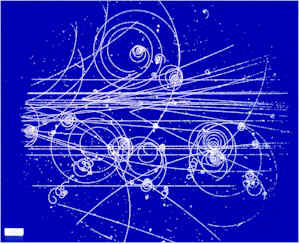
On The Large Hardon Collider and other particle accelerators
A quote from Steven Rado about particle accelerators
A quote from Steven Rado about particle accelerators
- "If [the] Aether is rehabilitated, particle physics should no longer be restricted to sterile mathematical speculations in the
unimaginable cosmic void. From this stand point of the existing Aether, all our modern particle accelerators and particle
smashers, with today's modern experimenters resemble to the kids in the bath tub, poking the water surface and
recognizing an infinite variety of patterns in the flow of the white soap layer. Some patterns are swimming surprisingly
far, almost like permanent designs, some others dissipates slowly, some others disappear as soon as they formed in the
wake of their fingers. According to their different life spans, these flow-patterns can be recorded, named, grouped and
filed into an infinite list of entities, however, due to the internal friction of the water and soap, none of them could really
be permanent. Nevertheless, – since the individual Aethrons have no internal structure and exert no forces on one
another, – one of the fundamental properties of the ideal fluid of Aether is being totally frictionless."
- See the Aether Reinstatement Page for how a particle accelerator can be used to prove the existence of the aether and
at the same time disprove some of the concepts of the special theory of relativity
| Why Electrons, Protons and Neutrons? |
The next page discusses the structure of the atom; including the "electromagnetic bond" that links an electron to a
proton; and the "strong force" that links a proton to a neutron. It further discusses the relation between a
quantum vortex and electromagnetic waves (radiation) and the wavelike nature of quantum vortices.
proton; and the "strong force" that links a proton to a neutron. It further discusses the relation between a
quantum vortex and electromagnetic waves (radiation) and the wavelike nature of quantum vortices.
Source:
Aethro-Kinematics
Aethro-Kinematics
Source:
Aethro-Kinematics
Aethro-Kinematics
Source:
Aethro-Kinematics
Aethro-Kinematics

Source: NASA
Particle trails in a cloud chamber of a particle accelerator: the physicists' bath tub!