| MAGNETISM PART II |

Bernoulli's Principle Applied to the Electrically-induced "Magnetic Field"
- Electrons moving through a cylindrically-shaped wire induce a sink along the entire length of the wire. The sink immediately
induces a cylindrical spiral vortex in the surrounding aether-medium in the plane perpendicular to the electrons' motion.
Whereas a gravity system has a sink at its center, the sink induced inside a wire is equivalent to a cylindrical sink along the
whole length of the wire. This is why the spiral vortex of the latter is cylindrically shaped. A cross section of the wire would
show a spiral vortex.
- Two sinks are operating here. In the first sink, the “positive” terminal of the battery to which the wire is connected is a sink
for the electrons. Thus, like a gravity system, the electrons are drawn through the wire towards this terminal.
- In the second instance, Bernoulli's principle explains, just like it does in the case of atomic and gravity systems, how a sink is
created along the length of the wire. As the drift-velocity of the aether inside the wire increases, due to the motion of the
electrons, its pressure decreases. The surrounding aether-medium moves in towards this area of decreased pressure to
equilibrate it. In the very beginning, the aether-medium moves in radial flowlines towards the wire, or cylindrical sink; but as
I explained earlier, such a global radial flow towards a sink rapidly evolves into rotational flow. The kinematic result is a
cylindrical spiral vortex surrounding the wire. (Remember that a wire is an aether-body that is penetrable by the aether-
medium.)
Summary of this page:
- The cylindrical (not circular) electrically-induced magnetic field around a wire with current.
- NOTE: A fuller explanation of the nature of spiral flow towards a common center is explained on the
Gravity Pages.


Whenever current, or electrons, pass through a wire, a "magnetic field" is created around it. Current
theory suggests this field is circular in nature. This is incorrect as I will explain.
theory suggests this field is circular in nature. This is incorrect as I will explain.
| The Aethro-Kinematics of an Electrically-Induced "Magnetic Field" (Aether Flowlines) |
This figure shows how an electrical
current induces a “magnetic field”
(aether flowlines) in the plane
perpendicular to the motion of the
electrons. The drawing on the left shows
the direction of the "magnetic field;" the
center picture shows how iron filings are
orientated around a wire with current;
the right picture gives an incorrect
represents of the nature of the
"magnetic field."
current induces a “magnetic field”
(aether flowlines) in the plane
perpendicular to the motion of the
electrons. The drawing on the left shows
the direction of the "magnetic field;" the
center picture shows how iron filings are
orientated around a wire with current;
the right picture gives an incorrect
represents of the nature of the
"magnetic field."
Bernoulli's Principle
Bernoulli's Principle:
Dynamic Pressure + Static Pressure = Total Pressure
- There is an inverse proportion between the velocity and pressure of a fluid
- For example, as the velocity, or dynamic pressure, of a fluid increases its static pressure decreases.
- The simplified version of Bernoulli's equation is the following:
Dynamic Pressure + Static Pressure = Total Pressure
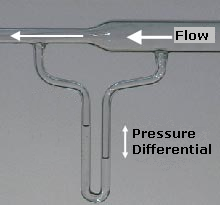
As the fluid moves through a more narrow tube
its velocity, or dynamic pressure, increases. This
causes the static pressure to decrease. The
tube connected to it, which has a fluid within it,
responds to this pressure change by moving
towards the area of lower static pressure.
its velocity, or dynamic pressure, increases. This
causes the static pressure to decrease. The
tube connected to it, which has a fluid within it,
responds to this pressure change by moving
towards the area of lower static pressure.
Bernoulli's Principle applied to the aether:
- The total pressure of the aether is unity; it is a conserved value. Any portion of the aether that has dynamic pressure
means there is a decrease in its static pressure. Dynamic pressure is a density disturbance of the aether. This causes
aethrons to be in anisotropic motion (non-random; direction-dependent).
- The spiral vortex and sink-source both represent areas of dynamic pressure. The aether-medium will move to equilibrate
this density disturbance by moving towards the area of lower static pressure.
- The pressure within the high drift-velocity of the sink-source flow is low; this low pressure, acting as sink, maintains a
spiral vortex around it; and, the spiral vortex, with its own high-drift velocity, in turn causes some of the sink-source flow
to be back-reflected. The sink in turn causes some of the aether to be sink-reflected towards it.
The battery induces a current
through the wire as explained
above. The "positive" terminal
acts a sink for the electrons
within the battery fluid. The
"negative" terminal represents a
sink for the electrons in the wire.
The electric current along the
wire represents a sink to the
aether-medium. The latter is the
"magnetic field" which is just
spiral flowlines of the aether.
through the wire as explained
above. The "positive" terminal
acts a sink for the electrons
within the battery fluid. The
"negative" terminal represents a
sink for the electrons in the wire.
The electric current along the
wire represents a sink to the
aether-medium. The latter is the
"magnetic field" which is just
spiral flowlines of the aether.
A Cylindrical Wire with Electric Current Induces a Cylindrical Sink Which Induces a Cylindrical Vortex Around it (a
"Magnetic Field").
The following two figures show how the entire wire acts as a sink. The dynamic pressure of the wire causes it to have
low static pressure. This low static pressure causes the surrounding aether to flow towards it to equilibrate the
density disturbance. Any flow of a fluid to a common center causes it to flow spirally. This is what occurs around wires
with a current of electrons passing through it.
The Faraday-Maxwell electromagnetic theory of this “electrically induced magnetic field” only considers the tangential
component of the “magnetic field,” and totally neglects the radial flux toward the wire. This neglect is similar to that of
the tangential component of gravity.
"Magnetic Field").
The following two figures show how the entire wire acts as a sink. The dynamic pressure of the wire causes it to have
low static pressure. This low static pressure causes the surrounding aether to flow towards it to equilibrate the
density disturbance. Any flow of a fluid to a common center causes it to flow spirally. This is what occurs around wires
with a current of electrons passing through it.
The Faraday-Maxwell electromagnetic theory of this “electrically induced magnetic field” only considers the tangential
component of the “magnetic field,” and totally neglects the radial flux toward the wire. This neglect is similar to that of
the tangential component of gravity.
Summary
- Bernoulli's Principle explains all magnetic phenomena.
- The symmetrically aligned sink-source flow of the electrons in a bar magnet cause it to have a global sink-source
flow that mimics an individual electron. The sink-source flow of an electron is part of a self-sustaining torus vortex
explained by Bernoulli's Principle. Its sink-source flow is called an "electric field." An "electric field" and "magnetic
field" are one in the same kind of aether flows--that is, dynamic flowlines. - The movement of electrons through a wire induces a spiral sinkwards flow of the surrounding aether around the
wire. This is because the dynamic pressure of the electrons moving through the wire causes it to have a low static
pressure.
Source: Aethro-Kinematics
Source: Aethro-Kinematics
Source: Aethro-Kinematics
Source: Aethro-Kinematics
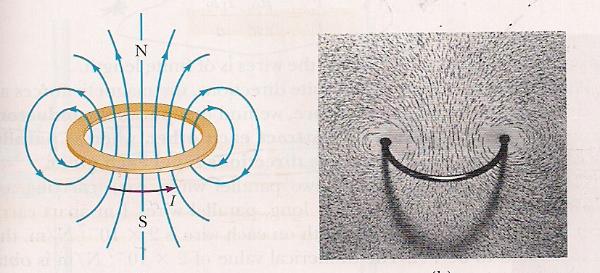
An electrically-induced magnetic flow through a wire that is circular in shape resembles a bar magnet's magnetic flow.
Source: Principles of Physics: Third Edition p. 829