| The Michelson-Morley Experiment |
Rationale of the Experiment
If the aether is motionless, as Maxwell said it must, then all other matter, such as planets, such experience a
drag force. On earth we should be able to detect and aether "wind" as the earth moves through the aether.
What the Experiment was Looking For
The Michelson-Morley experiment was designed to detect this aether wind should it exist. They compared a
source light with itself after being sent in different directions. They were looking for changes in the phase of light.
If there was an aether wind, the measurement of light taken as the earth moved towards the light source should
be higher than light that moved perpendicularly into earth.
The Mechanics of the Experiment
Michelson built the first interferometer for this experiment. An interferometer measures variances in the speed of
two rays of light that have traveled in perpendicular directions. By the use of mirrors, the apparatus would bring
the two rays of light together to produce an interference effect. Any change in speed of one of the rays of light
would result in a phase or fringe shift--that is, the troughs and crests would no longer line up in the same way
with the troughs and crests of the other ray, and this would show itself by changing the pattern of interference.
If the aether is motionless, as Maxwell said it must, then all other matter, such as planets, such experience a
drag force. On earth we should be able to detect and aether "wind" as the earth moves through the aether.
What the Experiment was Looking For
The Michelson-Morley experiment was designed to detect this aether wind should it exist. They compared a
source light with itself after being sent in different directions. They were looking for changes in the phase of light.
If there was an aether wind, the measurement of light taken as the earth moved towards the light source should
be higher than light that moved perpendicularly into earth.
The Mechanics of the Experiment
Michelson built the first interferometer for this experiment. An interferometer measures variances in the speed of
two rays of light that have traveled in perpendicular directions. By the use of mirrors, the apparatus would bring
the two rays of light together to produce an interference effect. Any change in speed of one of the rays of light
would result in a phase or fringe shift--that is, the troughs and crests would no longer line up in the same way
with the troughs and crests of the other ray, and this would show itself by changing the pattern of interference.


This is a diagram of the kind of interferometer that
M-M used to detect the "aether wind." Light was
emitted from a common source, and then deflected
and reflected such that the detector could measure
any "fringe" shifts, or differences in the velocity of light
as it moved with or against the motion of earth.
The stable fringe pattern found in the Michelson type
interferometers is caused by the separation of the
original source into two separate beams and then
recombining them at differing angles of incidence on a
viewing surface.
M-M used to detect the "aether wind." Light was
emitted from a common source, and then deflected
and reflected such that the detector could measure
any "fringe" shifts, or differences in the velocity of light
as it moved with or against the motion of earth.
The stable fringe pattern found in the Michelson type
interferometers is caused by the separation of the
original source into two separate beams and then
recombining them at differing angles of incidence on a
viewing surface.
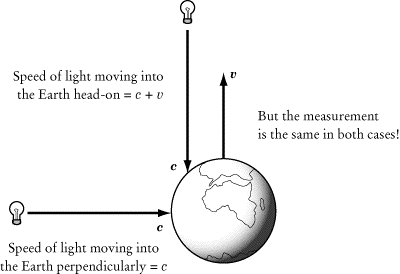
In other words, if the earth is
moving through a motionless
aether than the speed of light
moving into the earth head on
should be higher than light
moving into the earth
perpendicularly. The
measurement, however,
showed that the speed is the
same in both cases.
moving through a motionless
aether than the speed of light
moving into the earth head on
should be higher than light
moving into the earth
perpendicularly. The
measurement, however,
showed that the speed is the
same in both cases.
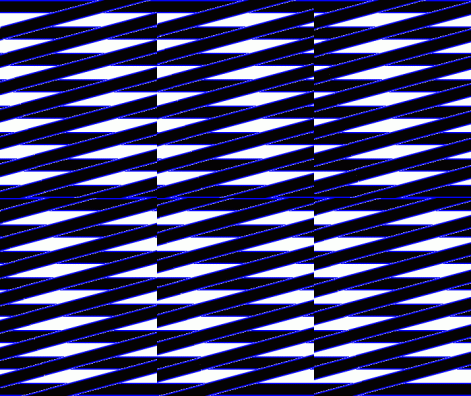
This animation shows
the angled beam's
phase moving ahead of
the reference beams
causing a constant
fringe shift to the left.
Black/Blue lines
represent wave peaks.
White spaces between
lines represent troughs.
the angled beam's
phase moving ahead of
the reference beams
causing a constant
fringe shift to the left.
Black/Blue lines
represent wave peaks.
White spaces between
lines represent troughs.
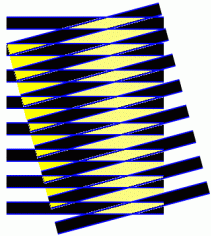
Yellow areas produce bright lines
of constructive interference. The
dark areas produce dark lines of
destructive interference.
of constructive interference. The
dark areas produce dark lines of
destructive interference.
In the Michelson-Morley experiment, the distance the two beams traveled down the perpendicular arms was expected
to be altered by a wind caused by the earth's motion through the stationary aether. This additional path length was
calculated to be .4 wavelengths. This means that as the interferometer's arms were spun to face into and against the
ether wind, the vertical fringe lines should have moved across the viewer .4 fringe widths left and right for a total of .8
fringes from maximum to minimum. Michelson reported that only between one-sixth and one-quarter of the expected
reading was found.
The experiment thus produced only a null result: no change in the speed of light was detected. In other words, it
failed to detect the motionless aether.
to be altered by a wind caused by the earth's motion through the stationary aether. This additional path length was
calculated to be .4 wavelengths. This means that as the interferometer's arms were spun to face into and against the
ether wind, the vertical fringe lines should have moved across the viewer .4 fringe widths left and right for a total of .8
fringes from maximum to minimum. Michelson reported that only between one-sixth and one-quarter of the expected
reading was found.
The experiment thus produced only a null result: no change in the speed of light was detected. In other words, it
failed to detect the motionless aether.

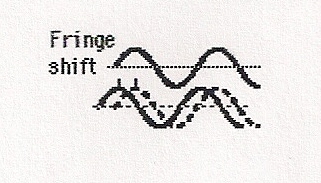
The addition of the orbital
velocity (30km/h) + the velocity of
the speed of light should produce
a detectable fringe shift in the
light wave.
velocity (30km/h) + the velocity of
the speed of light should produce
a detectable fringe shift in the
light wave.