| The Photoelectric Effect |

| Light as "Quantum of Energy" The Photoelectric Effect: Light as Photon |
Origin of the Idea of the "Quantum of Energy" and "Photon"
- How can a particle, a discontinuous entity because it has definite boundaries, emit and absorb radiated
energy, which is supposedly infinitely continuous?
- The problem disappears when one realizes radiated energy cannot be continuous. If it were, there
would be no maximum energy threshold: a wave could, over time, impart an impossibly high energy to a
particle.
- Planck introduced the idea that radiated energy must be emitted in discrete quantities, called quantums
of energy. Yet, even though he reasoned that it must be emitted in discrete quantities, he believed that
once emitted, the energy is radiated in waves.
- Einstein extended Planck’s idea of discrete emittance of radiation to absorption of radiation. He assumed
that the energy of light must be concentrated in a particle-like manner—in a photon—to be absorbed by
a particle. Once the quantum of energy was radiated it preserved its identity as a photon until it was
finally absorbed. In the special theory of relativity it was shown that mass and energy are identical
(E=mc^2): since photons have energy they must have mass. This bold conclusion, along with his denial
of the aether, instigated a plunge of physics into darkness for more than a century. It seemed impossible
to reconcile the fact that light, which unmistakably acts like a wave, must be emitted and absorbed in
quantums like a particle. Compton even experimentally proved that X-rays, high energy electromagnetic
waves, collide with electrons as if they are “hard” particles.
- Einstein used the idea of the "photon" to explain the photoelectric effect.
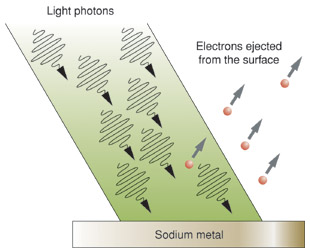
Photoelectric Effect: As light hits
the surface of a sodium metal
plate, electrons are emitted. For
this to occur, light was impart
energy to the metal plate in
quantum units. Einstein called
these units "photos."
the surface of a sodium metal
plate, electrons are emitted. For
this to occur, light was impart
energy to the metal plate in
quantum units. Einstein called
these units "photos."
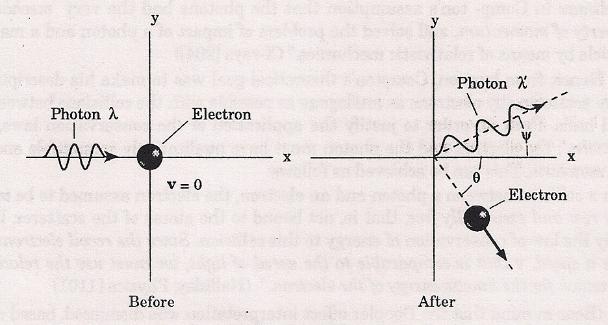
Compton Effect:
Light collides with
an electron in a
particle-like way.
This seems to
confirm that light
has
particle-properties.
Light collides with
an electron in a
particle-like way.
This seems to
confirm that light
has
particle-properties.
Source: Aethro-Kinematics
Origin of the "Wave/Particle" Duality of Light
In spite of the photon theory of light, it undeniably exhibits many wavelike properties (refraction,
diffraction, reflection, polarization), it is necessary that it be considered a wave, in addition to being
considered a particle. This assumed dualism makes it impossible for us to actually know what light is.
If waves in general are a disturbance of a materiate medium, what kind of medium can space be?
Since the aether has been rejected, how can light be part wave? What is it a wave of? Einstein said
we just have to take it for granted that space has this physical property.
Notice in the figure above of the photoelectric effect that the artist attempts to depict the photon
particle as a "packet of waves." However, the wave/duality theory of light states that light cannot
even be represented, since our "classical" way of understanding the world, as an either/or (either
wave or particle) does not apply to the quantum world.
In spite of the photon theory of light, it undeniably exhibits many wavelike properties (refraction,
diffraction, reflection, polarization), it is necessary that it be considered a wave, in addition to being
considered a particle. This assumed dualism makes it impossible for us to actually know what light is.
If waves in general are a disturbance of a materiate medium, what kind of medium can space be?
Since the aether has been rejected, how can light be part wave? What is it a wave of? Einstein said
we just have to take it for granted that space has this physical property.
Notice in the figure above of the photoelectric effect that the artist attempts to depict the photon
particle as a "packet of waves." However, the wave/duality theory of light states that light cannot
even be represented, since our "classical" way of understanding the world, as an either/or (either
wave or particle) does not apply to the quantum world.
| Wave/Particle Duality of Light |

Click Here for a description of the two-slit experiment that confirms the wave-nature of light, but
presents a new problem of how individual electrons sent through the slits could produce wave-like
results.
presents a new problem of how individual electrons sent through the slits could produce wave-like
results.